Ailanthus altissima (commonly called `the tree of heaven’) is a fast-growing, invasive, and deciduous tree species that is native to China. It is one of the first examples of a tree species that has become `naturalized’ in the United States after being introduced in the late 1700s.
It grows in dense thickets and releases chemicals that inhibit the growth of other native plant species. It can also be responsible for damaging road and sidewalk infrastructures. Because of all of this, Ailanthus altissima is responsible for causing economic and ecological problems in areas where it is able to grow. Furthermore, it is a significant host for the invasive spotted lanternfly.
This guide explains effective tree of heaven removal methods. These strategies are similar to the professional approaches used by experienced arborists when dealing with invasive tree species.
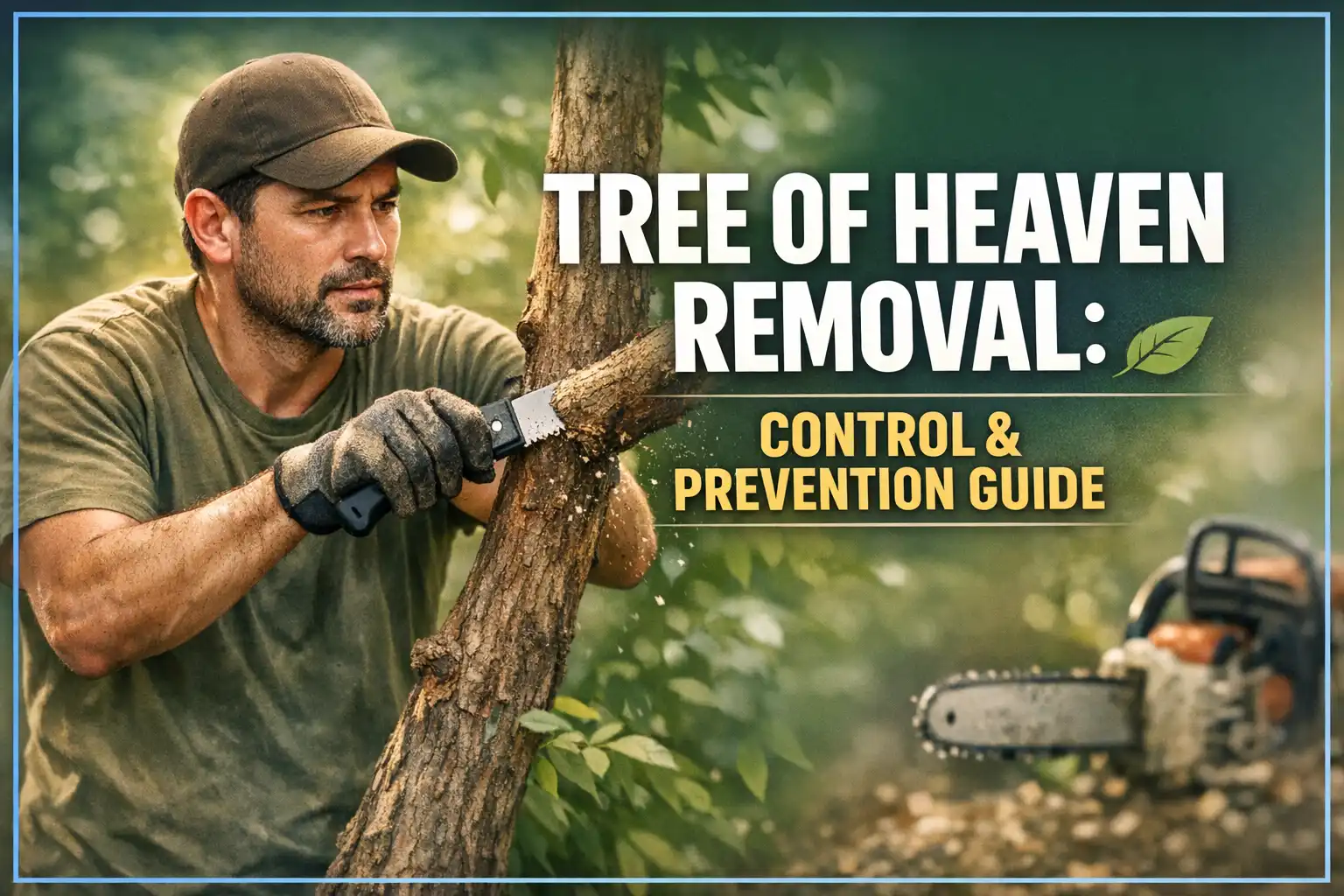
Tree of Heaven Removal or Ailanthus Altissima Removal
The tree of heaven, or Ailanthus altissima, is classified as a highly invasive species. This is because specific techniques have to be employed in order to mitigate resprouting, such as applying herbicides or other forms of post-removal control. If a tree of heaven is cut down without the appropriate post-removal control, it will most likely result in the formation of large numbers of root suckers. This will further the aggressive spread of the tree of heaven to surrounding areas. Then, how to get rid of the tree of heaven in a way that actually works? Below are some og the best methods.
1. Basal Bark Application
Basal bark application for heaven tree removal starts by spraying a mixture of herbicide, typically 20-30% triclopyr ester and oil carrier, onto the lowest 12-18 inches of trunk. This method is best for trees with a diameter of less than 6 inches, and the best time for application is late summer to early fall.
How to Apply:
- Apply in mid-to-late summer (July-September) when the tree is moving nutrients to the roots.
- Spray the bark from the ground line, up to 12–18 inches high.
- Use a 20-30% solution (e.g., 1 quart of Triclopyr ester mixed with 3 quarts of bark oil).
- Ideal for stems less than 6 inches in diameter.
- Do not apply to wet or frozen bark, and avoid applications just before rain.
2. Hack And Squirt
Hack and squirt is the most effective method for Ailanthus altissima removal. This method utilizes a hatchet to make downward-angled cuts around the trunk. The concentrated herbicide, 50% triclopyr or glyphosate, is directly applied into the cuts. Hack-and-squirt, a method that involves making cuts in a tree and applying herbicide to prevent regrowth, stops root suckering and is also performed in the late summer or early fall.
How to Apply:
- Apply in late summer to early fall, between August and September.
- Use a 50% formulation of Triclopyr (e.g., Garlon 3A, Vastlan) or Glyphosate in water.
- Make downward-angled cuts (hacks) that penetrate the bark into the cambium layer (just below the bark).
- Immediately spray 1–2 mL of herbicide into each cut.
- For trees over 6 inches in diameter, make one cut per 3-4 inches of diameter, or roughly one hack per inch of diameter.
3. Cut Stump Method
The cut stump method for invasive tree removal (Ailanthus altissima) requires immediately applying high-concentration glyphosate or triclopyr to the stump within 5 minutes of cutting. The immediate application prevents vigorous resprouting. This technique works well in summer. It is also effective in early fall. Proper care after removal is also important. It helps to understand what to do after stump grinding to manage the area properly.
How to Apply:
- The cut and stump method is best from mid july to mid october.
- Use a saw to cut the tree close to the ground.
- Within 5 minutes (or as soon as possible), paint or spray a 20-50% glyphosate or triclopyr solution onto the cut surface.
- Wear appropriate personal protective equipment (PPE), such as gloves and eye protection.
4. Hand Pulling Method
The hand-pulling method is one of the effective tree of heaven control methods when the seeds are under 1.5 inches tall. However, it is not recommended for large trees; instead, the above-mentioned methods can be used to prevent aggressive root suckering.
How to Hand Pull:
- Pull in early spring or when the soil is moist to make removing the long taproot easier.
- Grab the seedling at the base and pull slowly to avoid breaking the root.
- You must remove the entire root system. Any remaining fragments can resprout.
- This method is only effective for young seedlings.
- Use a weed wrench or dig out seedlings to ensure the roots are removed.
5. Grubbing Method
The grubbing method involves physically removing the entire root system to prevent resprouting. The grubbing method is more effective for small saplings and young trees.
- The best time to use grubbing is between late summer and early fall.
- Young, small seedlings can be pulled by hand, but it is critical to remove the entire root.
- For slightly larger trees, mechanical extraction or digging tools can be used.
- Grubbing is not recommended for mature trees, as they have extensive, deep root systems.
- Regular monitoring is essential for several years, as new shoots will likely appear.
Conclusion
The tree of heaven, or Ailanthus altissima, is a fast-growing invasive tree. Even though the tree of heaven is not dangerous to human health, it contains chemicals that prevent other plants from growing. This is where you need professional tree removal services. As we have discussed above, the tree of heaven can be removed by following the methods discussed, such as basal bark application, hack and squirt application, cut stump method, hand pulling method, and grubbing method.
If you’re wondering “how to get rid of the tree of heaven“, Alexa’s Tree Services LLC can help. With years of experience, they have a team of experts who can effectively remove your tree of heaven. Are you looking for an effective and reliable arborist in Vancouver? Then Alexa’s Tree Services LLC is the name to remember. Call now!
FAQs
Why is the tree of heaven considered invasive?
Because it grows rapidly, spreads through root suckers, and releases chemicals that inhibit native plant growth.
What is the most effective way to remove the tree of heaven?
The hack-and-squirt method using a systemic herbicide is widely considered the most effective.
When is the best time to remove the tree of heaven?
Late summer to early fall is ideal, as the tree is actively moving nutrients to its roots.